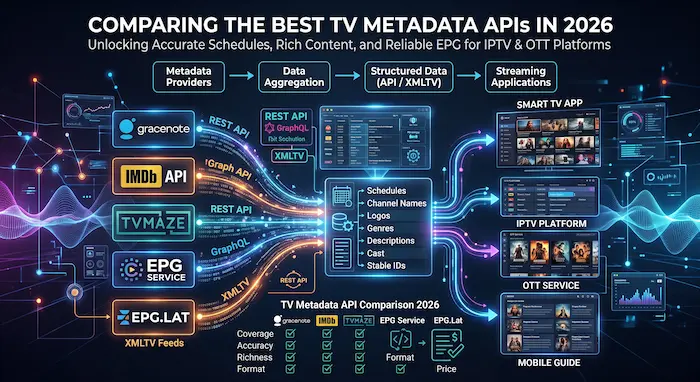
Choosing the right TV metadata API can make the difference between a polished streaming application and a TV guide that constantly shows missing channels, incorrect schedules, or outdated program information.
If you are building a live TV platform, IPTV application, OTT service, Smart TV app, or digital TV guide, you need more than a list of program titles. A useful TV metadata service may need to provide channel information, schedules, program descriptions, genres, images, identifiers, languages, and reliable timing data.
The challenge is that these services are not interchangeable. Some specialize in entertainment metadata, some focus specifically on live TV schedules, while others provide XMLTV feeds that are easier for smaller IPTV projects to integrate.
In this guide, we’ll compare several options available in 2026, explain their strengths and limitations, look at pricing models, and show which type of service makes sense for a startup, independent developer, or larger streaming platform.
What Is a TV Guide Metadata API?
A TV Guide Metadata API is a programmatic service that allows an application to retrieve structured information about television channels and programs.
Instead of manually maintaining a database such as:
Channel: ESPN
Program: SportsCenter
Start: 18:00
End: 19:00
Description: ...
your application can request the information from a remote API and receive structured data.
A typical workflow looks like this:
TV Metadata Provider
        ↓
      REST API
        ↓
 Your Backend
        ↓
 Channel Mapping
        ↓
 Database / Cache
        ↓
 IPTV / OTT Application
Depending on the provider, the response may contain:
- Channel IDs
- Channel names
- Program titles
- Episode information
- Start and end times
- Genres
- Descriptions
- Cast and crew
- Ratings
- Images and logos
- Language information
- Geographic availability
- Sports events
- Program identifiers
This is different from simply downloading an XMLTV file. An API can allow your backend to request specific data when it needs it, while an XMLTV feed is normally a structured document containing a larger batch of schedule information.
For a broader explanation of the architecture, see our guide to TV Guide Metadata APIs and how they work.
What Makes a Good TV Metadata API?
Not every provider is suitable for every streaming project. Before choosing a service, I would evaluate at least six things.
1. Schedule Accuracy
For a live TV application, inaccurate schedule data is not a minor problem. If your application says a football match starts at 20:00 when it actually started at 19:00, users quickly lose confidence in the guide.
Look for providers that explain:
- How schedules are collected
- How frequently data is updated
- How corrections are handled
- Whether data is normalized
- How time zones are represented
For example, Gracenote’s airing metadata represents start and end times in UTC, with the appropriate offset applied when displaying local time. That kind of detail matters when your application serves users in multiple countries.
2. Channel Coverage
A provider might have excellent movie metadata but poor coverage of the channels your customers actually watch. Before signing a contract, check:
- Country coverage
- Channel count
- Cable channels
- Satellite channels
- FAST channels
- Regional channels
- Sports channels
- International channels
This is particularly important for IPTV and international OTT services.
3. Program Metadata
A basic EPG might only tell you:
Movie — 20:00–22:00
A richer metadata service can provide: Movie title + description + genre + cast + rating + artwork + identifiers.
For a modern streaming application, richer metadata can improve:
- Search
- Recommendations
- Program pages
- Voice search
- Content discovery
- Personalized recommendations
4. Stable IDs
This is one of the most overlooked parts of metadata integration. You don’t want your backend to identify a program only by its title. For example:
The Office
The Office
The Office
could refer to different versions, languages, seasons, or episodes. A strong identifier system makes it easier to synchronize:
Channel
   ↓
Program
   ↓
Series
   ↓
Episode
   ↓
VOD Asset
This becomes particularly valuable when your platform combines live TV with an on-demand catalog.
The Best TV Metadata APIs and Services in 2026
There isn’t one universal “best” API. The right choice depends on whether you’re building a commercial OTT platform, a TV guide, an IPTV application, or a smaller developer project.
1. Gracenote
Best for: Enterprise TV, OTT and advanced entertainment metadata
Gracenote is one of the strongest options for organizations that need professional TV listings and entertainment metadata. Its developer platform provides APIs around Lineups, Stations, Programs, Series, Movies, Sports, and Airings.
- Strengths: Extensive metadata, professional TV listings, strong channel/lineup model, program identifiers, sports support, enterprise infrastructure.
- Weaknesses: The main disadvantage for a small developer is complexity and commercial access. R&D/Commercial functionality requires a contract.
- Verdict: Excellent for serious commercial TV and OTT platforms, but potentially excessive for a small independent project.
2. IMDb API
Best for: Movie, TV and entertainment metadata
IMDb is extremely well known, but there is an important distinction here. IMDb is not primarily a replacement for a live TV EPG provider. Its current developer products provide metadata for movies, TV and OTT series (Ratings, Genres, Plot, Cast).
- Strengths: Recognized database, rich title metadata, GraphQL API, extremely useful for VOD catalogs.
- Weaknesses: It isn’t the obvious choice if your main requirement is live TV schedules. Access also involves AWS Data Exchange and subscription approval.
- Verdict: Excellent for entertainment metadata; not the first choice for a live TV schedule backend.
3. TVmaze
Best for: Developers, prototypes and TV-show applications
TVmaze provides a REST API containing TV information, including Shows, Episodes, Cast, and Schedules. Its public API is free and returns JSON.
- Strengths: Easy REST API, JSON, free public access, developer-friendly documentation, great for prototypes.
- Weaknesses: Not designed to be a complete global IPTV/OTT channel metadata infrastructure.
- Verdict: A good starting point for developers building TV-show applications or smaller projects.
4. EPG Service
Best for: IPTV operators and OTT platforms that need EPG data directly
EPG Service is directly aligned with the TV-guide use case, covering thousands of channels across 60 countries with REST API, JSON, and XMLTV delivery.
- Strengths: EPG-focused, JSON & XMLTV formats, normalized and validated metadata, international coverage.
- Weaknesses: Commercial pricing depends on requirements, which may be more than a hobby project needs.
- Verdict: A strong candidate for an IPTV/OTT operator that wants a dedicated EPG provider rather than building the pipeline itself.
5. EPG.lat
Best for: Independent IPTV developers, testing and XMLTV-based projects
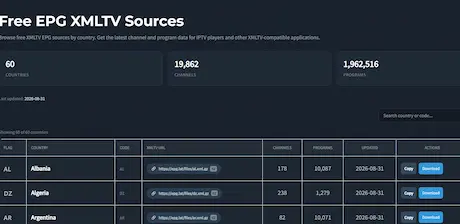
This is where EPG.lat takes a different position. It would be misleading to present EPG.lat as a direct enterprise API equivalent to Gracenote. Its current public service is primarily an XMLTV-based EPG source, with country-specific compressed XMLTV feeds.
The public EPG directory currently lists feeds for numerous countries, including the US, UK, France, Germany, Morocco, Spain, and others. That makes EPG.lat particularly interesting for Independent IPTV developers, testing, personal TV guides, and developers who don’t need enterprise metadata licensing.
Example: A developer can retrieve a country-specific XMLTV feed such as:
https://epg.lat/files/us.xml.gz
Why is this interesting? Because not every project needs an expensive enterprise API. If your application already understands XMLTV, a ready-made XMLTV feed can be much simpler:
EPG.lat XMLTV
      ↓
Your Backend
      ↓
Channel Mapping
      ↓
IPTV / OTT Application
- Strengths: XMLTV format, country-specific feeds, extremely simple integration, highly accessible to independent developers.
- Weaknesses: Not an enterprise platform. If your company needs contractual SLAs, advanced VOD metadata, or commercial licensing, evaluate a commercial API instead.
- Verdict: A practical option when your application needs ready-to-use XMLTV data without the complexity of an enterprise contract.
TV Metadata API Comparison
| Provider | Main Strength | Live TV Schedule | Rich Metadata | Delivery | Best For |
|---|---|---|---|---|---|
| Gracenote | Enterprise TV metadata | ✅ | ✅ | REST-style APIs | Large OTT platforms |
| IMDb API | Entertainment metadata | Limited | ✅ | GraphQL | VOD & entertainment apps |
| TVmaze | Developer-friendly data | ✅ | ✅ | REST API | Developers & prototypes |
| EPG Service | EPG infrastructure | ✅ | ✅ | REST & XMLTV | IPTV/OTT operators |
| EPG.lat | Accessible XMLTV feeds | ✅* | Basic | XMLTV (.gz) | Independent IPTV projects |
*Availability and suitability depend on the specific feed and channel mapping.
How Much Does a TV Metadata API Cost?
There is no universal price. The pricing model usually depends on the amount of data your application needs.
Free
Suitable for Learning, Prototypes, Personal projects, and Testing. TVmaze offers a public free API, subject to its rate limits. EPG Service also offers a free sandbox.
Developer/Startup
You may pay a monthly subscription for higher rate limits, commercial licensing, and better support. TVmaze’s published Startup plan is around $250/month.
Enterprise
Large streaming services need Global coverage, SLAs, Custom licensing, and Dedicated support. This is where pricing commonly becomes contract-based (e.g., Gracenote).
What Is the Difference Between an API and an EPG Feed?
TV Metadata API

        ↓

   Request specific data

        ↓

     JSON / GraphQL

        ↓

    Your Backend
XMLTV EPG Feed

        ↓

 Download schedule data

        ↓

 Parse XML

        ↓

 Channel Mapping

        ↓

 IPTV / OTT Player
API vs XMLTV: Which Should You Choose?
The answer depends on your architecture.
Choose an API when: You need specific records on demand, you need program IDs, and you are building a commercial backend with scalable integrations.
Choose XMLTV when: Your IPTV player already supports XMLTV natively, you want a simple EPG source, and you are importing schedules in bulk batches.
And in some cases, you can use both. This hybrid approach allows your backend to work with a modern API while still supporting legacy applications that expect XMLTV:
Commercial Metadata API
        ↓
   Your Backend
        ↓
     Database
        ↓
  Generate XMLTV
        ↓
   IPTV Players
How to Choose the Right API for Your Streaming App
Don’t choose a provider simply because it has the largest channel count. Instead, ask these questions:
- Which countries do you support? A provider with 50,000 channels is useless if most of your users need channels that aren’t covered.
- Do you need live schedules or VOD metadata? A VOD service cares about posters and cast. A live TV platform cares about Lineups and Time zones.
- Do you need XMLTV? If your existing infrastructure uses XMLTV, choosing a provider that supplies it saves development work.
- Do you need an SLA? If your customers depend on your TV guide every day, downtime becomes a business problem.
- What is your actual monthly volume? Don’t pay for enterprise infrastructure if your application has only a few hundred users.
Final Verdict
There is no single winner in the TV metadata market.
- Gracenote is one of the strongest choices for professional TV listings and rich entertainment metadata.
- IMDb is a premium entertainment metadata source rather than a dedicated live-TV EPG provider.
- TVmaze is attractive for developers because of its accessible REST API.
- EPG Service is highly relevant to IPTV operators looking for dedicated EPG infrastructure.
- EPG.lat occupies a useful position as a practical choice for independent developers who primarily need ready-to-use XMLTV feeds without committing to an enterprise contract.
Start with the smallest solution that meets your requirements—and upgrade the metadata infrastructure when your application actually needs it.
Frequently Asked Questions
There is no universal winner. Gracenote is a strong enterprise option, EPG Service is focused specifically on EPG infrastructure, TVmaze is developer-friendly, and EPG.lat is useful for XMLTV-based projects.
Yes. TVmaze provides a public free API under its published terms, while EPG Service currently offers a free sandbox for development and testing.
Not in the traditional EPG sense. IMDb’s current API products focus on entertainment metadata for movies, TV and OTT titles rather than functioning as a general replacement for live channel schedules.
Not necessarily. XMLTV is a data format, while an API is a method of accessing data. They solve related but different problems.
Yes, provided the application supports XMLTV and the channel IDs in the playlist can be correctly mapped to the IDs in the EPG data.
You should check the current terms and licensing conditions for the specific use case before using any feed commercially. Availability of an XMLTV URL does not automatically mean that every commercial redistribution or repackaging use is licensed.
XMLTV vs TV Metadata API: Which Is Better for IPTV and OTT in 2026?
“Before setting up your XMLTV feed or metadata backend, you can test and verify your M3U playlist lines using our free IPTV Checker Pro Online tool.”

