XMLTV vs TV Metadata API is a common question when developers build an IPTV app, OTT platform, live TV service, Smart TV application, or streaming product.
At first glance, both appear to solve the same problem: getting television guide and program information into an application. In practice, they operate at different layers.
XMLTV is primarily a standardized format for representing TV listings, while a TV Metadata API is a programmatic interface for retrieving structured television data. That distinction becomes important when a project grows from a simple EPG integration into a multi-device streaming platform.
If your main requirement is a reliable EPG that an IPTV player can read, XMLTV is often the simplest choice. If you are building a commercial OTT platform with search, recommendations, multiple devices, VOD integration, richer metadata, and international coverage, a metadata API or a hybrid architecture may be a better fit.
Quick answer: Choose XMLTV when you mainly need channel schedules and straightforward IPTV EPG integration. Choose a TV Metadata API when you need richer metadata, program relationships, search, discovery, VOD data, or a scalable backend. For larger platforms, using both can be the most flexible architecture.
XMLTV vs TV Metadata API at a Glance
| Feature | XMLTV | TV Metadata API |
|---|---|---|
| Main purpose | Represent TV listings and EPG data | Programmatic access to structured TV metadata |
| Typical delivery | XML file or feed | API requests and responses |
| Common response format | XML | Often JSON, sometimes XML or another format |
| IPTV player integration | Excellent when the player supports XMLTV | Usually requires backend integration |
| Schedules | Yes | Yes, depending on provider |
| Rich program metadata | Depends on the feed | Usually stronger and more structured |
| Search and discovery | Limited by the feed and your own implementation | Better suited to application-level search |
| Program identifiers | Depends on the source | Often a core part of the provider’s data model |
| VOD metadata | Possible but not its main purpose | Often available from commercial metadata providers |
| Implementation complexity | Low to medium | Medium to high |
| Best fit | Traditional IPTV and EPG workflows | OTT, discovery, multi-device platforms |
The important point is that XMLTV and an API are not always direct competitors. XMLTV describes how listing data is represented, while an API describes how an application retrieves data. A backend can therefore consume an API and generate XMLTV for IPTV clients.
What Is XMLTV?
XMLTV is an XML-based format for representing television listings. The XMLTV project documents the format and tools used to gather, process, and consume TV guide information.
For a basic IPTV workflow, an XMLTV document normally contains channel definitions and programme entries. A simplified valid example looks like this:
<?xml version="1.0" encoding="UTF-8"?>
<tv>
  <channel id="channel-1">
    <display-name>Example TV</display-name>
  </channel>

  <programme start="20260818180000 +0000"
              stop="20260818190000 +0000"
              channel="channel-1">
    <title>Evening News</title>
    <desc>Daily international news and analysis.</desc>
    <category>News</category>
  </programme>
</tv>
Notice the difference from an incorrectly simplified example: id, start, stop, and channel are attributes of the appropriate XMLTV elements.
XMLTV can represent more than just a title and time. Depending on the feed and implementation, TV listing data can include descriptions, categories, credits, ratings, episode information, languages, and image references.
Why Is XMLTV So Popular for IPTV?
The biggest advantage of XMLTV is simplicity.
Suppose an IPTV playlist contains a channel identifier:
#EXTINF:-1 tvg-id="channel-1",Example TV
https://example.com/live/channel1.m3u8
And the EPG contains the same channel identifier:
<channel id="channel-1">
  <display-name>Example TV</display-name>
</channel>
The IPTV application can use the matching identifier to associate the stream with its programme schedule.
Basic mapping:
M3U tvg-id → XMLTV channel id → Programme → Start/End time → EPG displayed in the player
This is why XMLTV remains practical for IPTV applications. You do not necessarily need a large metadata platform if the only requirement is to show viewers what is currently airing and what comes next.
What Is a TV Metadata API?
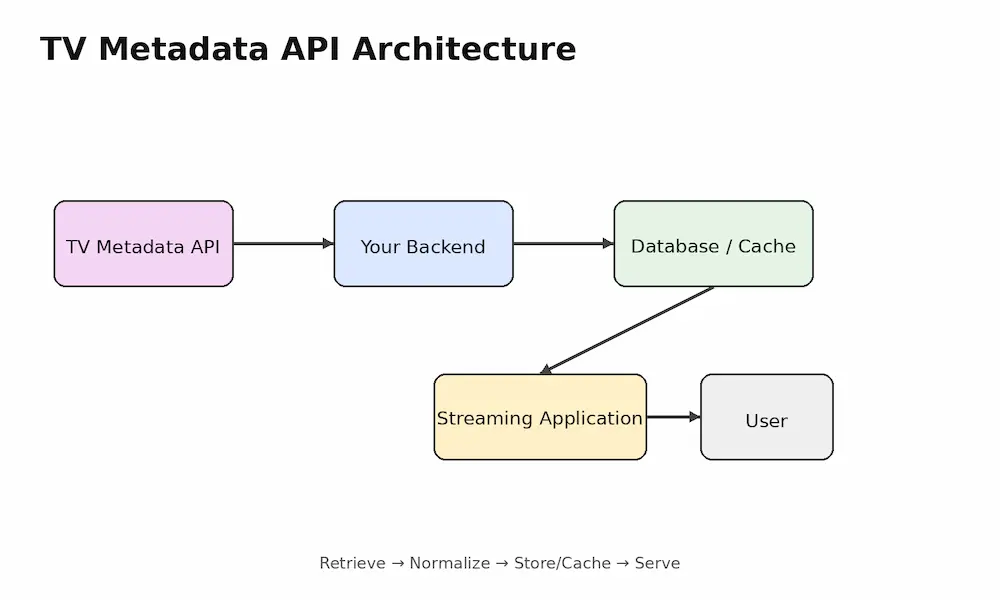
A TV Metadata API provides structured television information through programmatic endpoints. Instead of downloading one large guide file and processing everything on the client, your backend can request the data it needs and store or transform it.
A simplified architecture might look like:
GET /channels
GET /channels/{id}/schedule
GET /programs/{id}
A response could contain information such as:
{
  "id": "123456",
  "title": "Example Sports",
  "description": "Live sports coverage",
  "genre": "Sports",
  "startTime": "2026-08-18T18:00:00Z",
  "endTime": "2026-08-18T20:00:00Z"
}
The exact structure depends on the provider. Commercial metadata APIs can expose channel lineups, schedules, program information, images, genres, cast, crew, and other structured fields. For example, Gracenote’s developer documentation describes separate resources for lineups, channels, schedules, and program information.
“If you decide that a metadata API is the right fit for your streaming app, check out our detailed guide on the Best TV Guide Metadata APIs for Streaming Apps in 2026 to compare providers like Gracenote, TVmaze, and EPG.lat.
XMLTV vs API: The Biggest Difference
The easiest way to understand the difference is to think in terms of data representation versus data access.
XMLTV asks: How should television listing data be represented?
An API asks: How does my application retrieve and interact with structured data?
That means you can have:
API → JSON

API → XML

Provider → XMLTV → IPTV application
You can also build a backend that consumes a metadata API, normalizes the information, stores it in a database, and then exposes the result as XMLTV to legacy IPTV players and JSON to modern applications.
Which Is Better for IPTV?
For a traditional IPTV application, XMLTV is often the easier option.
If your application mainly provides:
- M3U playlist support
- EPG support
- Channel logos
- Favorites
- Categories
- Basic catch-up functionality
you may not need a sophisticated metadata API.
A simple architecture can be:
M3U + XMLTV
      ↓
Your Backend
      ↓
IPTV Player
XMLTV is a strong choice when:
- You already use an IPTV player that supports XMLTV.
- Your primary requirement is programme schedules.
- You do not need extensive VOD metadata.
- You want a relatively simple integration.
- Your EPG provider already supplies the data you need.
If you are working with playlists and need to validate stream information before mapping EPG data, you can also use your existing IPTV Checker Pro Online workflow.
When Does a TV Metadata API Make More Sense?
The decision changes when an IPTV project becomes a broader content platform.
Consider a service with:
- Thousands of channels
- Multiple countries and markets
- Search
- Recommendations
- Catch-up TV
- VOD
- Sports discovery
- Multiple languages
- Smart TV applications
- Android and iOS applications
At that point, you are no longer just displaying an EPG. You are building a content discovery system.
A richer metadata model can connect:
Channel
   ↓
Programme
   ↓
Series
   ↓
Season
   ↓
Episode
   ↓
VOD Asset
   ↓
Search / Discovery
That relationship between content entities is one of the strongest reasons to introduce a metadata API and a normalized backend database.
XMLTV vs TV Metadata API for OTT Platforms
For an OTT platform, the comparison becomes more nuanced because OTT applications often need much more than live-TV schedules.
Live TV
Channel → Current Programme → Next ProgrammeVOD
Movie → Genre → Cast → Rating → ArtworkSeries
Series → Seasons → EpisodesSearch
User Query → Metadata → ResultsRecommendations
User Behavior
      ↓
Content Metadata
      ↓
Recommendation Engine
XMLTV can be excellent for the live-TV portion, but it is not necessarily the best foundation for every content-management and discovery requirement of a modern OTT platform.
Does XMLTV Always Use Less Bandwidth?
Not necessarily.
It is tempting to say that XMLTV uses less bandwidth simply because it is downloaded as a file. The real answer depends on how much data the feed contains and how your application retrieves, parses, and caches it.
A large XMLTV feed may contain many channels, several days of schedules, long descriptions, images, multiple languages, and other metadata.
A basic XMLTV workflow might be:
Download feed
     ↓
Parse XML
     ↓
Store relevant data
     ↓
Serve clients
An API workflow might instead be:
Request required data
     ↓
Receive response
     ↓
Normalize
     ↓
Cache
     ↓
Serve clients
However, repeatedly calling an API without caching can also create unnecessary traffic. A well-designed backend can use application caching, Redis, scheduled synchronization, database indexes, compression, and other optimization techniques.
Therefore, XMLTV versus API does not automatically determine bandwidth consumption. Architecture does.
Performance: XMLTV vs API
For a small IPTV project, an XMLTV file can be very efficient after it has been downloaded and parsed.
The challenge appears when the dataset becomes large or when every client repeatedly downloads the same information.
Instead of doing this:
EPG Provider
     ↓
Every Client downloads the full dataset
a scalable architecture can do this:
EPG Provider
     ↓
Your Backend
     ↓
Cache
     ↓
Database
     ↓
Your API / XMLTV
     ↓
Clients
This allows your backend to control how frequently the upstream provider is contacted and how much data each client receives.
Time Zones: A Critical EPG Issue
Time zones are one of the easiest ways to make an otherwise correct EPG appear broken.
For example:
20260818180000 +0000indicates a programme beginning at 18:00 with a UTC offset of +0000. The application must then display the programme according to the user’s intended timezone.
A robust pipeline should therefore look like:
Provider Time
     ↓
UTC / Offset Normalization
     ↓
Database
     ↓
User Timezone
     ↓
EPG UI
This becomes particularly important when your service covers multiple countries or markets.
XMLTV Channel Mapping and tvg-id
Channel mapping is one of the most important practical parts of an IPTV EPG architecture.
For example, your M3U playlist might contain:
#EXTINF:-1 tvg-id="bbc-one.uk",BBC One
https://example.com/live/bbc-one.m3u8
And your XMLTV data could contain:
<channel id="bbc-one.uk">
  <display-name>BBC One</display-name>
</channel>
The shared identifier allows your application to associate the stream with the correct guide data.
Relying only on channel names is less reliable because the same service may appear as:
- BBC One
- BBC ONE HD
- BBC One UK
- BBC One HD UK
A stable identifier is therefore preferable to simple name matching.
Important: A valid EPG URL does not automatically mean the guide will display correctly. The playlist channel identifier and the XMLTV channel identifier must be mapped correctly.
Can You Use XMLTV and an API Together?
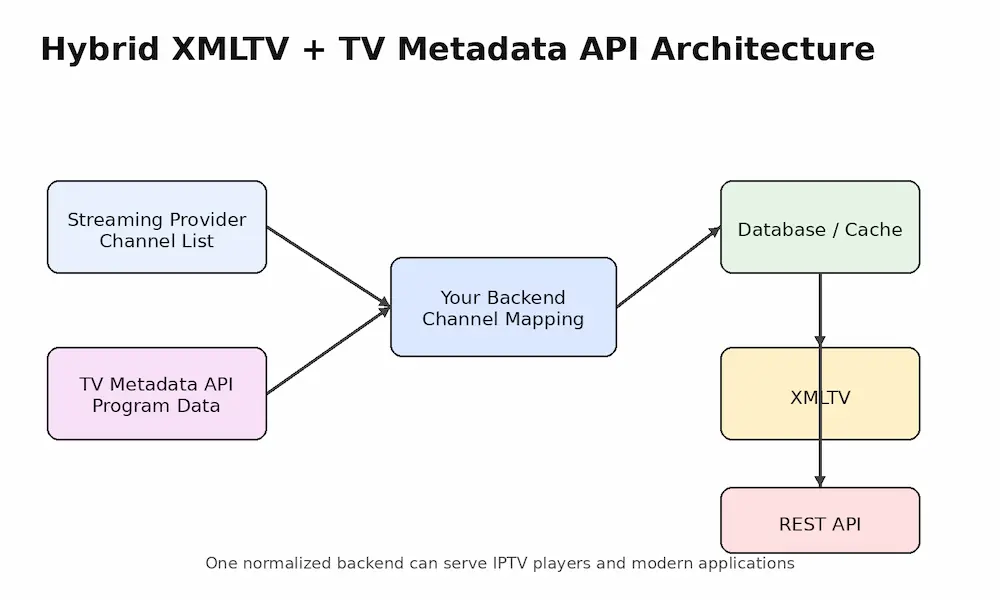
Yes. In fact, a hybrid architecture is often the most practical solution for a growing streaming platform.
        TV Metadata API
               ↓
        EPG Ingestion
               ↓
     Validation & Mapping
               ↓
       Normalized Database
               ↓
          Redis / Cache
            ↙       ↘
         XMLTV      REST API
           ↓           ↓
      IPTV Players   Apps / Web / TV
This architecture separates the external data provider from your applications.
Your IPTV player can continue consuming XMLTV, while Android, iOS, web, and Smart TV applications can consume your own API.
Why a Hybrid EPG Architecture Can Be Better
Imagine you have three types of clients:
IPTV Player
Needs an XMLTV feed.
Android or iOS Application
May prefer JSON through a REST API.
Smart TV or Web Application
May need JSON, images, search, filtering, and additional metadata.
Instead of creating separate ingestion systems, you can normalize the external data once:
                 Provider
                    ↓
                EPG Backend
                    ↓
                Normalization
                    ↓
                 Database
               ↙    ↓     ↘
           XMLTV    REST   Search
             ↓       ↓       ↓
           IPTV    Apps    Web / TV
The normalization layer becomes the central point where you can clean, validate, map, cache, and transform the data.
Which Is Easier to Build?
If your goal is simply to get an EPG working quickly, XMLTV wins on simplicity.
You can download a feed, parse it, map the channels, and display the programme schedule.
If you are building a complete streaming platform, a metadata API or hybrid architecture provides more flexibility, although it also introduces more infrastructure and development work.
XMLTV vs TV Metadata API: Cost
Cost depends heavily on the provider, coverage, licensing, update frequency, and the amount of metadata you require.
A feed can be inexpensive compared with a commercial metadata platform, but developers should never assume that a publicly accessible feed is automatically licensed for unlimited commercial redistribution.
Commercial metadata services may charge for:
- Coverage
- Data licensing
- Update frequency
- Infrastructure
- Support
- Standardized identifiers
- Images and artwork
- Program relationships
- Sports metadata
- Commercial usage rights
For a small project, paying for capabilities you do not need may be unnecessary. For a commercial OTT service, however, unreliable metadata can create much larger operational and product costs.
XMLTV vs TV Metadata API for Developers
| Project | Recommended Starting Point |
|---|---|
| Personal IPTV player | XMLTV |
| Small IPTV application | XMLTV |
| Basic EPG website | XMLTV |
| IPTV management dashboard | XMLTV + backend |
| Android IPTV application | XMLTV or hybrid |
| Multi-device IPTV platform | Hybrid |
| Commercial OTT platform | Metadata API or hybrid |
| VOD + Live TV platform | Metadata API or hybrid |
| Large Smart TV platform | Metadata API / hybrid |
| Global streaming service | Enterprise metadata architecture |
This is not a strict rule. A small company can build an API-based architecture, and a large company can continue using XMLTV. The correct choice depends on the product requirements.
What Should You Choose in 2026?
If you are building an IPTV EPG, start with XMLTV unless you have a specific reason to use something more complex. It is mature, widely used, and designed around television listing data.
The XMLTV project maintains the XMLTV format, related tools, documentation, and release packages. Check the official release page for the latest version.
If you are building an OTT platform, live TV streaming service, or commercial application with sophisticated content discovery, evaluate a metadata API early.
If your requirements sit between these two extremes, a hybrid model can give you the best of both worlds.
The Practical Architecture I Recommend
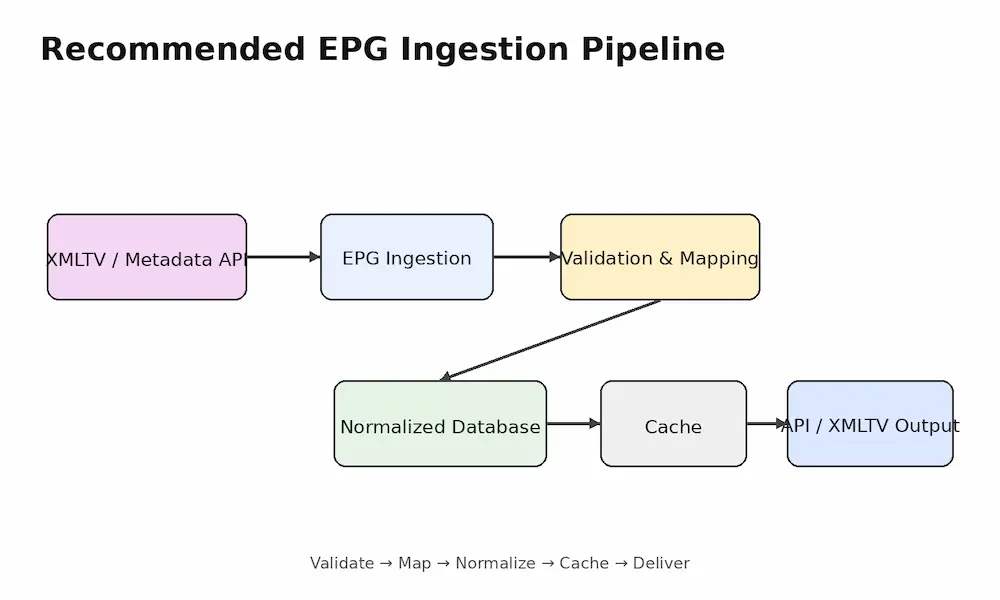
The most important component is not necessarily XMLTV or the external API. It is the normalization layer in the middle.
Your backend can use that layer to:
- Normalize channel names.
- Map channel identifiers.
- Normalize time zones.
- Validate programme start and end times.
- Remove duplicate programme records.
- Cache frequently requested data.
- Generate XMLTV feeds.
- Provide JSON to applications.
- Hide external provider credentials from clients.
- Make it easier to switch metadata providers later.
Example End-to-End Architecture
The complete workflow can be visualized like this:
End-to-end architecture: the streaming source provides the channel list, while the metadata source provides programme data. Both datasets enter your backend, where channel mapping and normalization take place before the result is stored and delivered.
The streaming source supplies channel information, while the metadata source supplies programme information. Your backend brings the two datasets together, maps the channels, stores the normalized result, and exposes EPG data to different clients.
XMLTV or TV Metadata API: Final Verdict
There is no universal winner.
Choose XMLTV if your priority is simplicity.
It is particularly suitable for traditional IPTV EPG applications where the main requirement is:
Channel → Programme → Start time → End time
Choose a TV Metadata API if your priority is richer data and application-level scalability.
This becomes more valuable when you need:
- Advanced TV guides
- Search and discovery
- Recommendations
- VOD integration
- Program identifiers
- Series and episode relationships
- Sports metadata
- Multiple markets
- Smart TV experiences
- Commercial OTT infrastructure
For a serious streaming platform, using both can be the most practical option. The API can serve as an upstream data source, while your backend becomes the normalization and caching layer and XMLTV remains a delivery format for IPTV players and legacy clients.
Frequently Asked Questions
Is XMLTV better than a TV Metadata API?
Not necessarily. XMLTV is a format for TV listing data, while a metadata API is a programmatic method of retrieving structured data. XMLTV is usually simpler for IPTV EPG integration, while APIs can be more flexible for sophisticated OTT applications.
What is the best EPG format for IPTV?
XMLTV is one of the most practical choices for IPTV because it is designed to represent television listings and is supported by many EPG workflows and applications.
Can an IPTV app use a TV Metadata API?
Yes. In many architectures, the API is better integrated into the backend rather than called directly by every IPTV client. The backend can retrieve, normalize, cache, and expose the data in a format appropriate for each application.
Can I convert an API response to XMLTV?
Yes. A backend can retrieve metadata from an API, normalize it, map the channels, and generate an XMLTV feed for compatible IPTV players.
Does XMLTV support program descriptions and images?
XMLTV can represent descriptions and a range of additional programme information. The exact fields available to your application depend on the feed and the implementation that produces it.
What is an EPG API?
An EPG API is an API that provides electronic programme guide information such as channels, programmes, schedules, start and end times, and potentially richer metadata.
What is the difference between an EPG and TV metadata?
An EPG primarily answers what is airing and when. TV metadata can go further by describing titles, genres, cast, ratings, artwork, identifiers, seasons, episodes, and other content relationships.
Is XMLTV suitable for an OTT platform?
Yes, especially for the live-TV component. However, an OTT platform that also needs VOD, recommendations, search, and rich content discovery may benefit from a dedicated metadata API or a hybrid architecture.
Final Recommendation
If you are building a simple IPTV service, do not over-engineer it. Start with a reliable XMLTV source and implement proper channel mapping.
If the project grows into a full OTT platform or live TV streaming application, introduce a metadata API and move EPG ingestion, normalization, caching, and channel mapping into your backend.
If you are designing the infrastructure from scratch, make the architecture flexible enough to support both XMLTV and API-based delivery.
Bottom line: XMLTV is usually the better starting point for straightforward IPTV EPG needs. A TV Metadata API becomes more valuable as your platform needs richer metadata, search, VOD, recommendations, multiple markets, and multiple client applications. A hybrid architecture gives growing platforms the flexibility to support both.
Related Resources
- IPTV Checker Pro Online — validate IPTV playlist and connection data.
- M3U to EPG Converter — work with playlist data when preparing EPG information.

