Buying a new TV in 2026 is no longer just about choosing a brand or buying the largest screen you can afford.
Hisense, Samsung, LG, TCL and Sony all offer 4K Smart TVs, but they take different approaches to picture quality, display technology, gaming, software and premium features.
Hisense and TCL are particularly competitive when it comes to large screens and Mini-LED technology. Samsung offers a broad premium lineup built around Neo QLED, QLED and OLED, while LG remains a major OLED choice. Sony takes a different approach, placing strong emphasis on image processing, motion and cinematic picture quality.
So, which TV brand is actually best?
There is no universal winner. The better choice depends on your budget, room, viewing habits, gaming needs, preferred display technology and Smart TV platform.
Hisense vs Samsung vs LG vs TCL vs Sony: Quick Comparison
| Brand | Main Strength | Best For | Main Technologies | Smart TV Platform |
|---|---|---|---|---|
| Hisense | Value and Mini-LED | Large screens and strong specifications for the price | ULED, Mini-LED, QLED | VIDAA, Google TV and others depending on model |
| Samsung | Premium all-round performance | Premium TVs, bright rooms and gaming | Neo QLED, QLED, OLED | Tizen |
| LG | OLED | Movies and gaming | OLED, QNED | webOS |
| TCL | Value and large screens | Mini-LED and affordable large TVs | Mini-LED, QLED | Google TV, Roku TV or Fire TV depending on model |
| Sony | Image processing | Movies, sports and home theater | OLED, Mini-LED, LED | Google TV |
The important thing to remember is that brand comparisons only take you so far. A premium Hisense can be very different from an entry-level Hisense, just as a premium Samsung, LG, TCL or Sony can be very different from a basic model.
Hisense: Best Value for Advanced TV Technology?
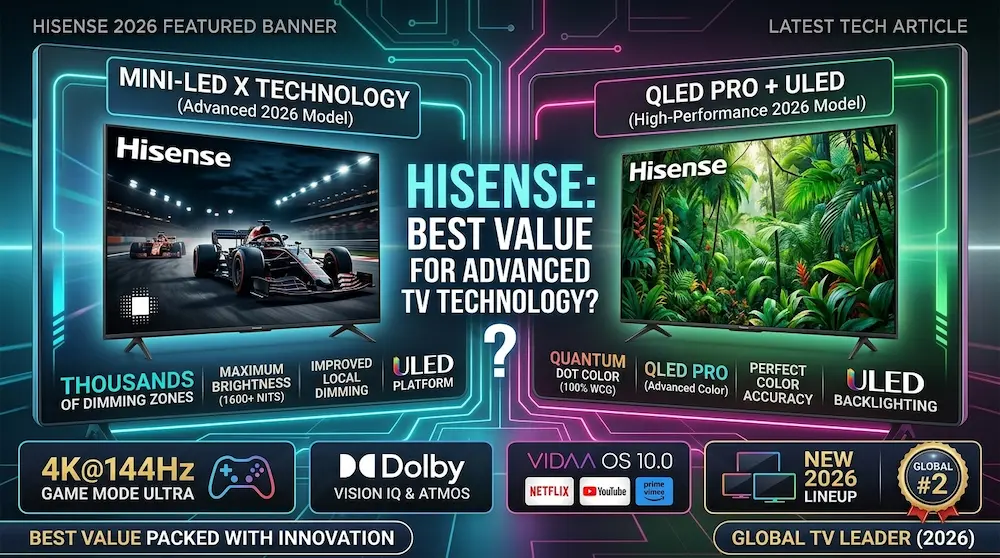
Hisense has moved well beyond the basic budget-TV category. Its higher-end televisions can include Mini-LED backlighting, Quantum Dot color, high brightness, local dimming, advanced image processing and high refresh rates.
The U7 and U8 families are especially interesting for buyers who want a high-performance LCD television without immediately moving into the most expensive premium categories.
Another important difference is the Smart TV platform. Depending on the country and model, a Hisense television may use VIDAA, Google TV or another platform.
Why choose Hisense?
- Strong price-to-performance ratio
- Competitive Mini-LED models
- Large screen options
- High brightness on premium models
- Strong gaming specifications on selected models
- Attractive 65-inch and 75-inch choices
- Very large-screen options
Where Hisense falls behind
The main issue is that Hisense model specifications and Smart TV platforms can vary considerably. A premium U8 should not be judged by the capabilities of an entry-level Hisense model.
The operating system also deserves attention. If you rely on specific streaming, media or IPTV applications, check the exact model and platform before buying.
Best for: buyers who want advanced display technology, large screens and strong specifications without paying the highest premium prices.
For a deeper look at Hisense models, VIDAA, Google TV, Mini-LED, apps and IPTV compatibility, see our Hisense TV 2026 guide.
Samsung: Best Premium All-Rounder?
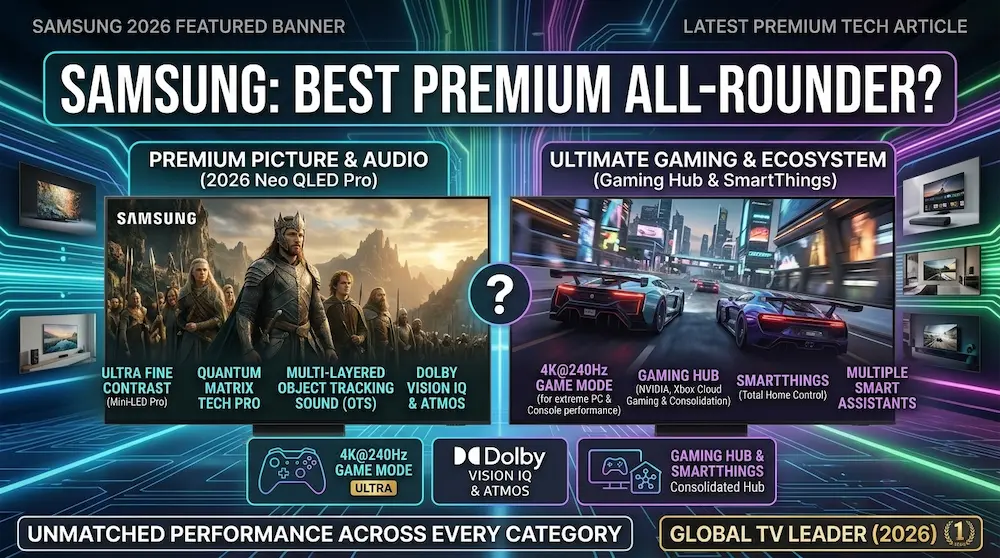
Samsung remains one of the most established names in the TV market, with a lineup that ranges from conventional LED models to QLED, Neo QLED Mini-LED and OLED televisions.
Neo QLED combines Mini-LED backlighting with Samsung’s image processing and premium picture features. Higher-end models are particularly attractive to buyers who want high brightness, strong HDR performance and advanced gaming features.
Why choose Samsung?
- Strong premium LCD technology
- Extensive Neo QLED Mini-LED range
- High brightness
- Mature Tizen Smart TV platform
- Strong gaming features
- Premium industrial design
- Wide selection of screen sizes
Where Samsung falls behind
Samsung’s premium models can become expensive, especially at larger screen sizes.
The product lineup can also be difficult for first-time buyers to navigate because models within different families can have significantly different specifications.
Best for: buyers who want a polished premium television with strong picture quality, brightness, gaming features and a mature Smart TV platform.
If you use IPTV on a Samsung television, our Samsung Smart TV IPTV setup guide explains how app compatibility and playlist setup work on the platform.
Samsung’s official TV lineup includes Neo QLED models with Tizen Smart TV features and gaming technologies.
LG: Is OLED Still the Best Choice for Movies?
If your priority is OLED picture quality, LG deserves serious consideration.
OLED pixels generate their own light, which allows OLED televisions to produce extremely deep blacks and excellent pixel-level contrast without relying on a conventional LCD backlight.
LG’s OLED televisions are also popular with gamers because of their fast response, high refresh rates and wide viewing angles on compatible models.
Why choose LG?
- Excellent OLED picture quality
- Extremely deep blacks
- Excellent contrast
- Wide viewing angles
- Strong gaming performance
- Mature webOS platform
- Strong support for modern HDR formats on compatible models
Where LG falls behind
OLED is not automatically the best choice for every room. A high-end Mini-LED television can produce very high brightness and may be a better fit for a bright living room.
Larger OLED televisions can also become expensive compared with similarly sized LCD and Mini-LED alternatives.
Best for: movie enthusiasts, gamers and buyers who prioritize OLED contrast and picture quality.
If IPTV is also part of your setup, see our IPTV on LG Smart TV guide for platform-specific installation and compatibility information.
TCL: Hisense’s Closest Competitor?
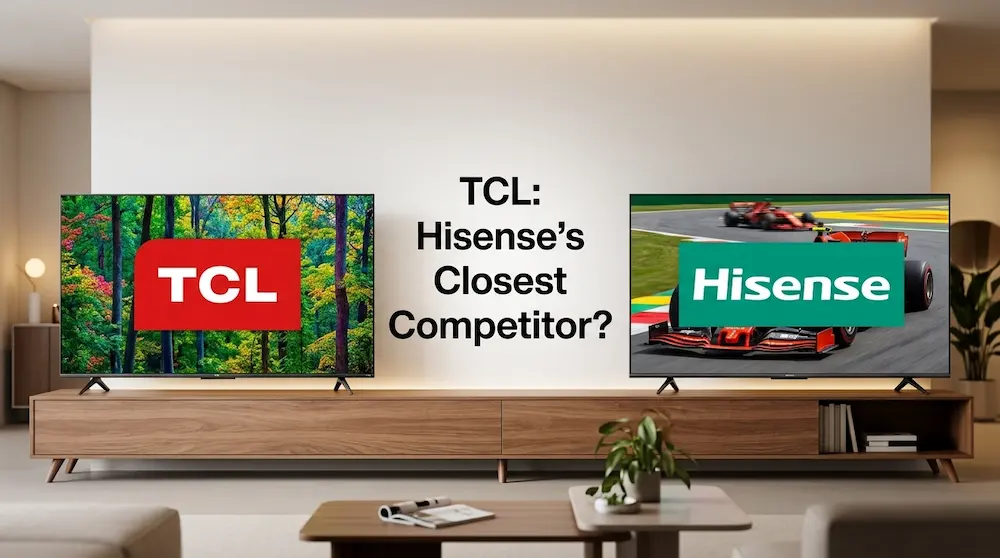
Among these five brands, TCL is one of the closest competitors to Hisense, especially for buyers focused on value, Mini-LED technology and large screens.
Both brands have expanded aggressively into advanced LCD and Mini-LED televisions while keeping many models below the price of traditional premium competitors.
Depending on the market and model, TCL televisions can use Google TV, Roku TV or Fire TV.
Why choose TCL?
- Strong value
- Competitive Mini-LED lineup
- Large-screen options
- Competitive pricing on larger sizes
- Google TV availability on many models
- Different Smart TV platform options depending on market
Where TCL falls behind
The difference between TCL product families can be substantial. An entry-level TCL should not be compared directly with a premium Mini-LED model simply because both carry the TCL name.
Best for: buyers looking for a large screen and advanced display technology at a competitive price.
Sony: Best for Movies and Image Processing?
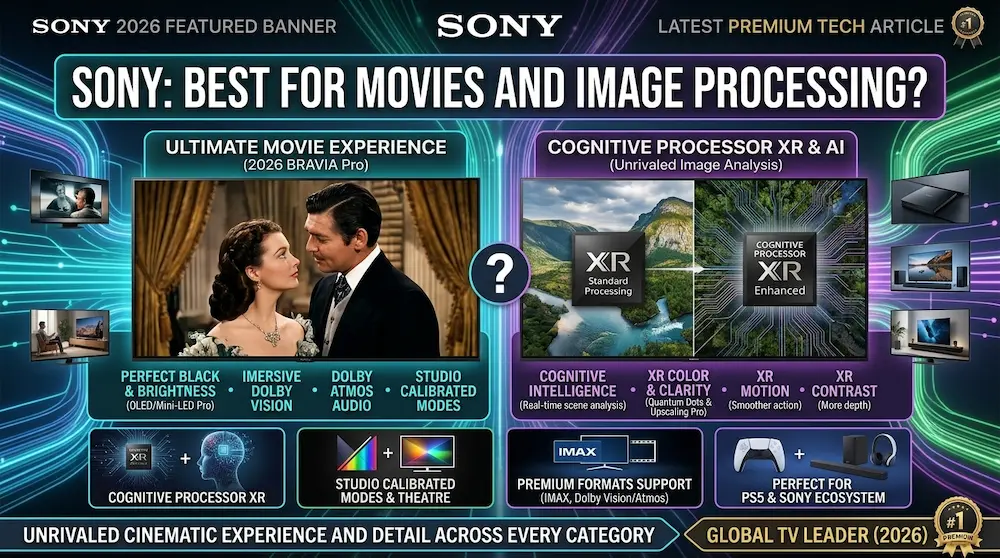
Sony approaches television somewhat differently from brands that compete primarily on headline specifications.
The company places significant emphasis on image processing, motion handling and cinematic presentation. This can make Sony particularly attractive to people who watch movies, sports and other content where processing quality matters.
Many Sony televisions use Google TV, giving compatible models access to a broad selection of streaming and Smart TV applications.
Why choose Sony?
- Excellent image processing
- Strong motion handling
- Excellent movie performance
- Premium OLED options
- Strong Mini-LED choices
- Google TV on compatible models
- Strong home-theater integration
Where Sony falls behind
Sony televisions can cost more than competing models with similar headline specifications.
If your priority is getting the largest possible screen or the highest specifications for the lowest price, Hisense and TCL may be more attractive.
Best for: movie lovers, sports viewers and buyers who value image processing and cinematic presentation.
Hisense vs Samsung: Which Is Better?
This comparison largely comes down to value versus premium refinement.
Choose Hisense if you want:
- More screen for your budget
- Competitive Mini-LED technology
- High brightness
- Large screen sizes
- Strong gaming specifications
Choose Samsung if you want:
- Neo QLED technology
- Premium design
- A mature Tizen experience
- Strong brightness
- A broad premium TV ecosystem
For a fixed budget, Hisense can often provide more display hardware for the money. Samsung becomes more attractive when the buyer is willing to spend more on the overall premium experience.
Hisense vs LG: Mini-LED or OLED?
This is one of the most interesting comparisons because the two brands often represent different display philosophies.
A premium Hisense Mini-LED can offer very high brightness and strong HDR impact, while an LG OLED can deliver extremely deep blacks and pixel-level contrast.
Choose Hisense Mini-LED if:
- Your room is very bright
- You want strong HDR brightness
- You want a large screen
- You prioritize value
Choose LG OLED if:
- You watch many movies
- You often watch TV in a darker room
- You want extremely deep blacks
- Viewing angles are important
- You want a premium gaming display
There is no universal winner. Mini-LED and OLED solve different problems.
Hisense vs TCL: Which Gives You More for Your Money?
This is arguably the most important comparison for value-focused shoppers.
Both brands offer Mini-LED televisions, large screens and competitive gaming features. The decision should therefore be based on the exact models, not simply the brand name.
When comparing two models, look at:
- Peak brightness
- Local-dimming performance
- HDR support
- Native refresh rate
- HDMI 2.1 support
- VRR
- Image processing
- Smart TV platform
- Warranty
- Current price
If two televisions are similarly priced, the model with the better combination of panel performance, processing and features should win, regardless of whether it carries a Hisense or TCL logo.
Hisense vs Sony: Value or Processing?
This comparison is relatively straightforward.
Hisense generally places strong emphasis on specifications, large screens and value, while Sony places more emphasis on processing, motion and image presentation.
Hisense makes more sense if:
You want a large Mini-LED TV, high brightness and strong specifications without moving into the highest price brackets.
Sony makes more sense if:
You care more about movies, motion, image processing and a premium home-theater experience.
For sports and cinematic content, Sony’s processing can be particularly attractive. If you are primarily shopping by screen size and specifications, Hisense can be difficult to ignore.
OLED vs Mini-LED: Which Technology Should You Buy?
Before choosing a brand, it helps to decide which display technology makes the most sense for your room.
OLED
OLED televisions use self-emitting pixels, which means each pixel can control its own light output.
- Deep blacks
- Excellent contrast
- Very fast response
- Excellent viewing angles
- Strong cinematic performance
LG, Samsung and Sony all compete strongly in OLED.
Mini-LED
Mini-LED televisions use many small LEDs behind an LCD panel. Combined with local dimming, this can produce high brightness and strong contrast.
- Very high brightness
- Strong HDR impact
- Excellent contrast on well-designed models
- Wide selection of large screens
- Strong performance in bright rooms
Hisense and TCL are particularly competitive in this segment, while Samsung’s Neo QLED range is another major Mini-LED option.
Choose OLED when deep blacks, viewing angles and dark-room movie performance are your priorities.
Choose Mini-LED when brightness, large screens, HDR impact and bright-room performance matter more.
QLED vs Mini-LED vs OLED: What’s the Difference?
TV terminology can make shopping confusing because these terms describe different parts of the display technology.
QLED generally refers to an LCD television that uses Quantum Dot technology to improve color performance.
Mini-LED primarily describes the backlighting system. A Mini-LED television can also use Quantum Dot technology.
OLED uses self-emitting pixels rather than a conventional LCD backlight.
This means that QLED and Mini-LED are not mutually exclusive. A television can use both technologies.
That is why buyers should look beyond marketing names and examine the actual specifications of the model they are considering.
Which TV Brand Is Best for Gaming?
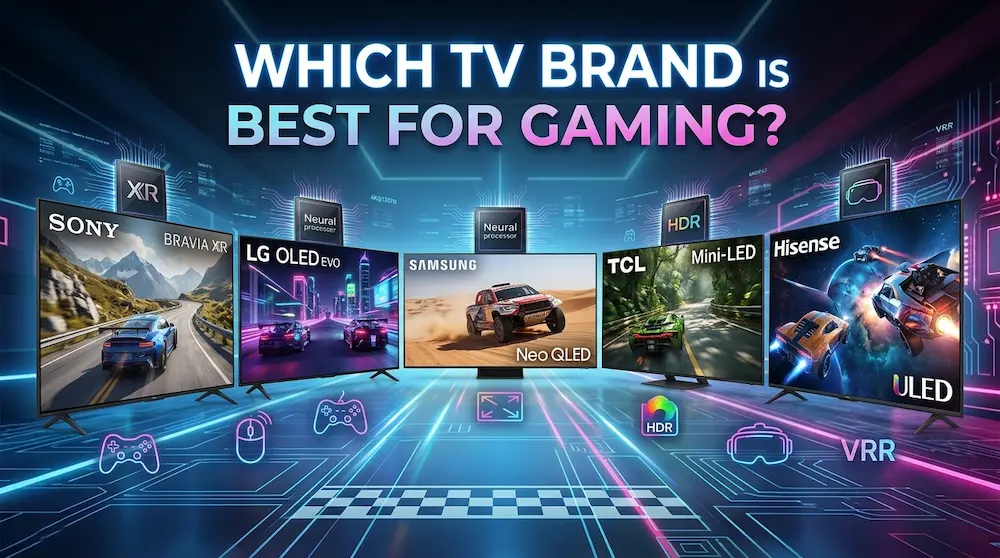
Gaming performance has become one of the most important features of modern televisions.
For a gaming TV, look for:
- 120Hz or higher refresh rate
- HDMI 2.1
- VRR
- ALLM
- Low input lag
- 4K high-refresh support
LG
A strong choice if you want OLED gaming performance and fast response.
Samsung
A strong premium gaming option across OLED and Neo QLED models.
Hisense
Attractive for gamers who want high-refresh Mini-LED performance without paying the highest premium prices.
TCL
A strong alternative for gamers who want large screens and competitive pricing.
Sony
A good fit for gamers who also place a high priority on movies and image processing.
Don’t buy a gaming TV based only on its advertised refresh rate. HDMI implementation, VRR support, input lag and the actual capabilities of the exact model matter just as much.
Which TV Has the Best Smart-TV Platform?
The operating system can be just as important as the panel, especially if you use specific streaming, media or IPTV applications.
| Brand | Platform | Main Advantage |
|---|---|---|
| Hisense | VIDAA / Google TV / others | Platform depends on model and market |
| Samsung | Tizen | Mature Samsung ecosystem |
| LG | webOS | Polished Smart TV interface |
| TCL | Google TV / Roku / Fire TV | Different platform options |
| Sony | Google TV | Strong Google ecosystem |
Google TV
Google TV is particularly attractive if application availability and flexibility are important. It is used by many Sony and TCL televisions and provides access to the Google TV and Android application ecosystem on compatible models.
Samsung Tizen
Tizen provides a mature Smart TV interface with strong integration into Samsung’s ecosystem.
LG webOS
webOS remains one of the most recognizable Smart TV interfaces and is closely integrated with LG televisions.
VIDAA
VIDAA focuses on a simple Smart TV experience, but its application ecosystem is more controlled than the Google TV and Android ecosystem.
This difference can matter if you rely on specialist applications, including certain IPTV players.
If you are choosing a TV specifically for IPTV, our IPTV setup guide covers players, M3U playlists, Xtream Codes and EPG considerations across different devices.
Which TV Is Best for IPTV?
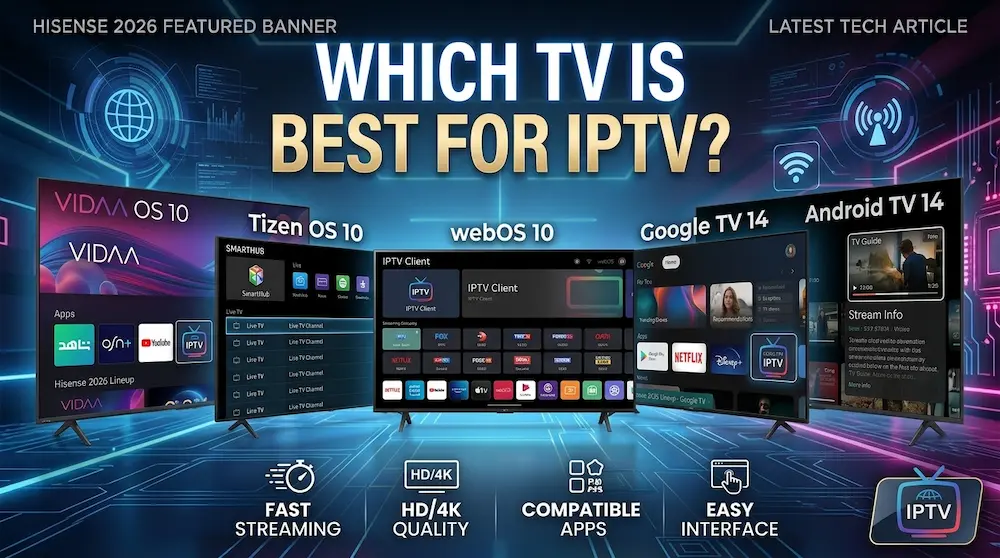
For IPTV users, the Smart TV platform deserves special attention.
The important question is not simply which brand has the best picture. It is:
Does the operating system on my exact TV model support the applications I need?
If you are still deciding which IPTV setup to use, our IPTV guide covers players, M3U playlists, Xtream Codes and EPG support.
Hisense
VIDAA models can support IPTV applications, but availability depends on the country, model and software version. Hisense models running Google TV provide access to a broader Google TV and Android application ecosystem.
Samsung
Samsung uses Tizen, so IPTV applications need to be compatible with Samsung’s TV platform.
LG
LG uses webOS and has its own application ecosystem, so compatibility should be checked for the specific application you want to use.
TCL
Google TV models generally provide greater application flexibility, while Roku and Fire TV models use their respective ecosystems.
Sony
Google TV models provide access to compatible applications from the Google TV ecosystem.
If IPTV application flexibility is important to you, check the operating system and application availability before buying rather than choosing purely by brand.
EPG support is another important part of the experience. You can find EPG TV XML sources for IPTV players in our XMLTV directory.
If you are testing an IPTV playlist before using it on your TV, our IPTV Checker can help you check whether stream links are responding correctly.
Which TV Size Should You Buy?
The right TV size depends on your room, viewing distance and how immersive you want the picture to feel.
| Size | Good Choice For |
|---|---|
| 55-inch | Bedrooms and medium-sized rooms |
| 65-inch | Many living rooms |
| 75-inch | Large living rooms and movie watching |
| 85-inch+ | Large rooms and home theater |
A 65-inch TV is often a useful middle ground between immersion and physical size. At 75 inches and above, Hisense and TCL can become particularly interesting for buyers looking for large screens at competitive prices.
At 85 inches and beyond, compare the exact panel, processing, brightness and local-dimming performance carefully rather than assuming that a larger screen automatically means a better TV.
Why 4K Resolution Isn’t Enough
Almost every serious television in this comparison is 4K, which means resolution alone is no longer a useful way to decide which TV is better.
Instead, pay attention to:
- Panel technology
- Brightness
- Contrast
- Local dimming
- HDR performance
- Color performance
- Image processing
- Refresh rate
- Viewing angles
- HDMI 2.1
- Operating system
A $500 4K television and a $2,000 4K television can have exactly the same resolution while producing very different images.
Which Brand Offers the Best Value?
Value is not simply about choosing the cheapest TV. It depends on how much display technology, screen size, smart features and gaming capability you get for the price.
Hisense and TCL are particularly interesting for buyers who want Mini-LED technology, large screens and strong feature sets without automatically moving into the highest premium price ranges.
Samsung offers a broader premium range, while LG is especially relevant for buyers interested in OLED. Sony tends to appeal to viewers who place greater emphasis on image processing, movie performance and overall picture refinement.
The best value therefore depends on the specific model, screen size and price available in your market rather than the brand name alone.
Hisense vs Samsung vs LG vs TCL vs Sony: Which TV Is Best?
There is no single TV brand that is best for every buyer. The right choice depends on the features that matter most to you.
- Hisense: A strong option for buyers who want advanced display technology and large screens at competitive prices.
- Samsung: A strong all-round choice with a wide premium range, advanced picture technologies and a mature Smart TV platform.
- LG: Particularly attractive for buyers who want OLED and strong gaming features.
- TCL: A compelling alternative for buyers interested in Mini-LED, large screens and competitive pricing.
- Sony: Especially worth considering for movies, image processing and cinematic picture quality.
Rather than choosing a winner based only on the brand, compare the specific model, display technology, screen size, Smart TV platform and current price.
The Best TV Depends on How You Watch
The right choice becomes easier when you start with how you actually use your TV.
| What matters most? | Brands worth considering |
|---|---|
| OLED movies and deep blacks | LG, Samsung, Sony |
| Mini-LED and large screens | Hisense, TCL, Samsung |
| Gaming | LG, Samsung, Hisense, TCL |
| Movie picture processing | Sony, LG |
| Smart TV and app flexibility | Depends on the exact platform and model |
| IPTV | Check app availability and platform compatibility first |
This approach is more useful than choosing a brand first. Start with your viewing habits, then compare the models that match your priorities and budget.
Our Verdict
Value-focused buyers should compare Hisense and TCL first, particularly when Mini-LED technology and large screens are high priorities.
OLED shoppers can focus on LG, Samsung and Sony, comparing the exact models and prices available in their market.
Premium Mini-LED buyers have several strong options, with Samsung, Hisense and TCL all worth considering.
For movies, sports and advanced image processing, Sony deserves special attention.