If you are searching for a Hisense TV, you will quickly discover that the brand offers much more than affordable 4K televisions. Hisense now has a broad range of 4K, QLED, Mini-LED, ULED, OLED and RGB Mini-LED TVs, with models designed for streaming, sports, gaming, movies and large-screen home entertainment.
One of the biggest questions for buyers is not only which Hisense TV has the best picture quality, but also which operating system it uses.
Depending on the model and market, a Hisense smart TV can use VIDAA, Google TV, Android TV, Fire TV or Roku TV. This difference matters because the operating system determines the interface, app store, streaming applications, voice features and, importantly for some users, the availability of IPTV player applications.
This guide explains the Hisense TV range, the VIDAA operating system, how VIDAA compares with Android TV and Google TV, the latest display technologies, current prices in the United States, United Kingdom and Canada, and what you should know about apps and IPTV on Hisense Smart TVs.
Hisense TV at a Glance
Hisense has become one of the most competitive TV brands for buyers looking for large screens, Mini-LED technology, high brightness and advanced gaming features at competitive prices.
The company now offers televisions ranging from affordable 4K models to premium ULED, Mini-LED and large-screen TVs. Its lineup also varies considerably by market, with different models and smart-TV platforms available in the United States, United Kingdom, Canada and other regions.
For buyers, this means that choosing a Hisense TV is not simply about comparing screen size or price. The display technology, operating system, available apps, gaming features and exact model can make a significant difference.
In the sections below, we look at Hisense TVs in detail, including VIDAA, Google TV, Mini-LED, ULED, gaming features, screen sizes, prices and IPTV app compatibility.
What Is a Hisense Smart TV?
A Hisense Smart TV is a television with an integrated operating system that allows you to connect to the internet, install or access applications, stream video, use voice assistants and access online services without necessarily requiring an external streaming box.
Hisense offers different smart-TV platforms depending on the country and model.
The company’s US platform information lists Android TV, Fire TV, Google TV, Roku TV and VIDAA TV among its smart-TV platforms.
This means that two Hisense televisions that look very similar can provide a significantly different software experience.
For example:
- A Hisense Google TV gives you access to the Google TV ecosystem.
- A Hisense Android TV uses the Android TV platform.
- A Hisense Fire TV integrates Amazon’s Fire TV ecosystem.
- A Hisense Roku TV uses Roku’s platform and Channel Store.
- A Hisense VIDAA TV uses Hisense’s own smart-TV operating system.
Always check the exact model and operating system before buying.
Where Is Hisense TV Made?
Hisense is a Chinese electronics company founded in Qingdao, China, in 1969. The company has grown into a global television manufacturer, selling TVs under the Hisense brand in markets including the United States, the United Kingdom, Canada, Europe and Australia.
So, where are Hisense TVs made? The answer depends on the model and the market. Hisense operates manufacturing facilities in different countries and also uses regional production and supply chains to serve local markets. As a result, the country of manufacture can vary between Hisense TV models sold in the US, UK, Canada and other regions.
For this reason, buyers looking for a “Hisense TV made in” specification should check the model’s packaging, product label or official specifications rather than assuming that every Hisense TV is manufactured in China.
Is Hisense a Chinese TV brand?
Yes. Hisense is a Chinese consumer-electronics company, although it is now a global brand with manufacturing, research, development and sales operations in multiple countries.
This global manufacturing strategy allows Hisense to offer televisions in different sizes, technologies and price ranges, including ULED, Mini-LED, QLED and large-screen TVs.
What Is VIDAA on Hisense TVs?
VIDAA is Hisense’s proprietary smart-TV operating system and user interface.
Unlike Android TV or Google TV, VIDAA is not simply an Android-based interface with the Google Play Store. It has its own software environment and its own application ecosystem.
VIDAA focuses on providing a relatively simple and fast TV interface, with access to streaming services and regional content.
The platform is also evolving. VIDAA’s newer HomeOS direction is designed to expand beyond traditional TV menus by adding personalization, AI features, connected-home functions, entertainment and other services.
The exact VIDAA version can depend on the television generation and market.
⚠️ Important: Check the Operating System Before Buying a Hisense TV
One of the most important things to check before buying a Hisense Smart TV is its operating system.
Not every Hisense TV is an Android TV or Google TV. Many models, particularly in some international markets, use VIDAA, Hisense’s own smart-TV platform.
This can be a surprise for buyers who assume that every Hisense Smart TV works like an Android TV.
VIDAA does not provide the same Google Play Store and Android app ecosystem available on Google TV or Android TV. As a result, some applications available on Android may not be available on a VIDAA television.
This is particularly important if you plan to use IPTV players, media applications or other specialized apps.
Before purchasing, check the exact model number and confirm:
- Which operating system the TV uses
- Which version of VIDAA is installed
- Whether the applications you need are available
- Whether your preferred IPTV player supports that specific model and region
Do not buy a Hisense TV assuming it is Android simply because it is advertised as a Smart TV.
If application flexibility is a priority, a Hisense model running Google TV or Android TV may be a better fit.
Why does VIDAA matter?
The operating system affects:
- Which applications are available.
- Which streaming services can be installed.
- Whether Google Play is available.
- How IPTV players can be installed.
- Voice-control features.
- The user interface.
- How quickly the television receives software updates.
- Compatibility with external devices and services.
For a buyer who only watches Netflix, YouTube, Prime Video and other mainstream services, VIDAA can be perfectly adequate.
For a more advanced user who wants thousands of Android applications or APK sideloading, Google TV or Android TV may provide greater flexibility.
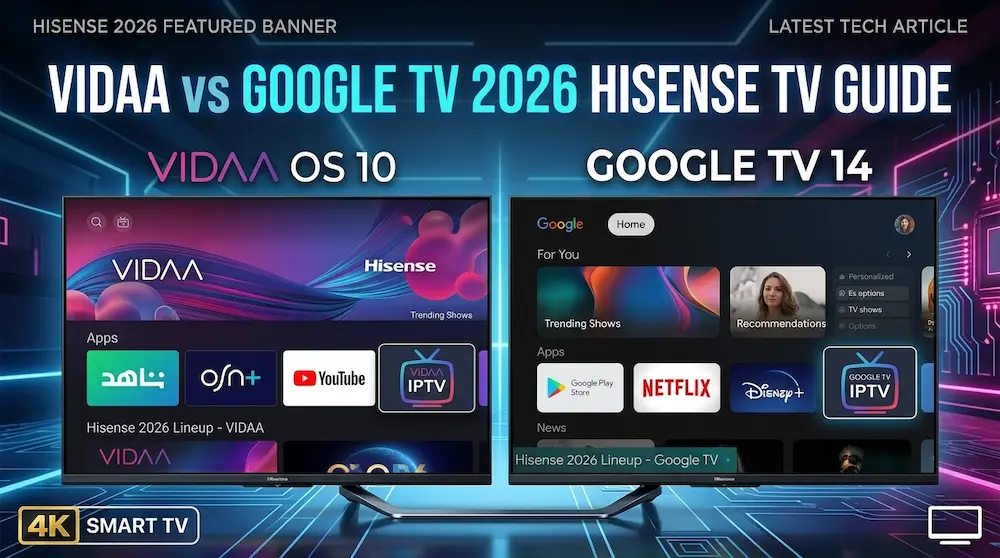
VIDAA vs Android TV vs Google TV
One of the most important decisions when buying a Hisense Smart TV is choosing the right operating system.
| Feature | Hisense VIDAA | Android TV | Google TV |
|---|---|---|---|
| Google Play Store | No | Yes | Yes |
| Android APK ecosystem | Limited | Yes | Yes |
| Interface | Simple and TV-focused | Android-based | Google content-focused |
| App selection | Regional/curated | Very large | Very large |
| IPTV flexibility | Model/region dependent | Excellent | Excellent |
| Google Assistant | Model dependent | Yes | Yes |
| Google ecosystem | Limited | Strong | Very strong |
| Sideloading | Restricted | Yes | Yes |
| Best for | Simple TV use | Maximum flexibility | Streaming + Google ecosystem |
VIDAA vs Android TV
The biggest difference is the application ecosystem.
Android TV gives you access to Google Play and a large collection of applications designed for television.
This can be particularly useful if you want specialized media players, IPTV players, file managers, alternative launchers or applications that are not available on proprietary smart-TV platforms.
VIDAA is more controlled.
You generally install applications through the TV’s own application store rather than treating the television like an Android device.
That can make VIDAA simpler for ordinary streaming, but less flexible for advanced users.
VIDAA vs Google TV
Google TV is Google’s newer TV experience built on the Android TV platform.
It combines Android TV capabilities with a content-focused interface and deeper integration with Google’s services.
For example, Google TV models can provide access to the Google Play ecosystem and support applications designed for Android TV.
This gives Google TV a significant advantage if you want maximum application compatibility.
However, that does not automatically make Google TV better for every buyer.
If you mainly watch Netflix, YouTube, Prime Video, Disney+ and local streaming services, VIDAA may provide everything you need with a simpler interface.
Hisense TV Technologies in 2026
The biggest reason to consider a modern Hisense television is not just the operating system.
The company’s recent televisions include several advanced display and processing technologies.
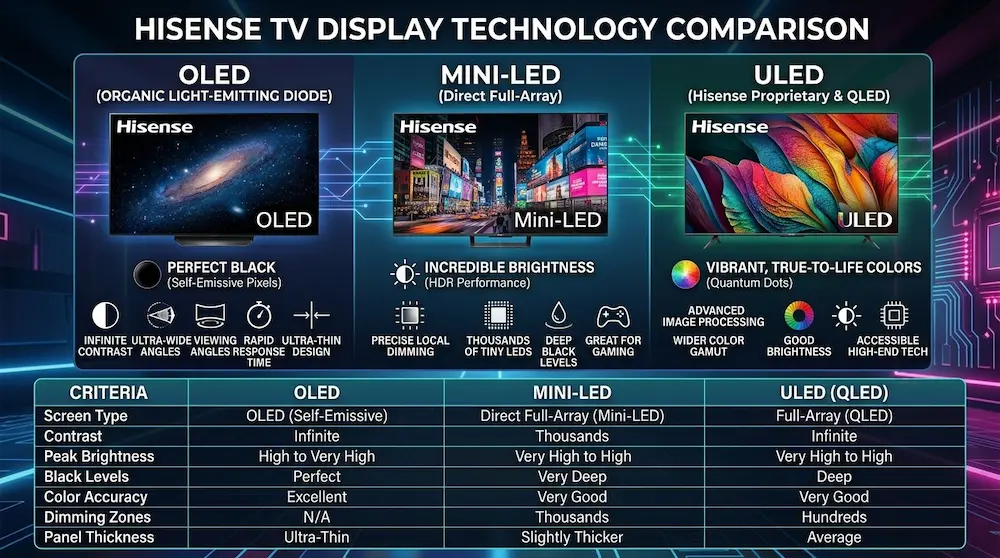
Mini-LED
Mini-LED is one of the most important technologies in the modern Hisense lineup.
Instead of using relatively large conventional LEDs, Mini-LED televisions use a much larger number of smaller LEDs to control the backlight more precisely.
The result can include:
- Higher brightness
- Better contrast
- Deeper blacks
- Better HDR performance
- More precise local dimming
- Reduced blooming compared with conventional LED TVs
Hisense’s 2026 ULED lineup continues to emphasize Mini-LED and Hi-QLED technologies.
ULED and Hi-QLED
Hisense uses the ULED name for a collection of picture-enhancement technologies rather than treating ULED as a completely separate panel technology like OLED.
Depending on the model, ULED televisions can combine technologies such as:
- Mini-LED backlighting
- Quantum Dot color
- Local dimming
- AI image processing
- High refresh rates
- HDR support
Hisense also uses Hi-QLED branding on several newer models.
This makes it important to look beyond the ULED name and check the specifications of the exact model.
Hi-View AI Engine
Modern Hisense televisions increasingly use AI-based image processing.
The Hi-View AI Engine is designed to analyze incoming content and optimize elements such as detail, color, contrast and upscaling.
Higher-end models use the Hi-View AI Engine PRO.
For example, Hisense’s U8Q specification lists the Hi-View AI Engine PRO together with Mini-LED PRO and a native 165Hz gaming mode.
AI processing is particularly useful when watching lower-resolution content on a 4K television because the TV has to upscale that content to the panel’s native resolution.
144Hz and 165Hz Gaming
Gaming is another area where Hisense has become increasingly competitive.
Depending on the model, newer televisions can offer:
- 120Hz
- 144Hz
- 165Hz
- VRR
- ALLM
- HDMI 2.1
- Game Mode
- Gaming overlays and game bars
The Hisense U7Q, for example, supports a 144Hz Game Mode PRO, while the U8Q increases the native refresh rate to 165Hz.
This makes higher-end Hisense models particularly interesting for PlayStation 5, Xbox Series X/S and PC gaming.
However, refresh rate alone should not determine your purchase. HDMI bandwidth, VRR implementation, input lag and the actual panel specifications are equally important.
RGB Mini-LED: Hisense’s High-End Direction
Hisense is also pushing RGB Mini-LED technology into its premium range.
Instead of relying solely on conventional white LED backlighting combined with a color layer, RGB Mini-LED uses individually controlled red, green and blue light sources.
In the US market, the 2026 lineup includes premium RGB Mini-LED models such as the UR8 and UR9, alongside more affordable U6 and U7 Mini-LED televisions.
This technology is positioned above conventional ULED models and is intended to deliver improvements in brightness, color volume and contrast.
Hisense TV Model Comparison
Hisense uses different model families for different price and performance levels.
The exact names vary between countries, so a U7 model in the US does not necessarily have exactly the same specifications as a similarly named model in Europe or Canada.
Model names vary by market. For example, US models may use names such as U75QG or U8QG, while UK versions can use different model codes and specifications. Always compare the full model number, not just the U7 or U8 series name.
Entry-level and budget models
These models generally focus on:
- 4K resolution
- Basic HDR
- Smart-TV functionality
- Affordable prices
- Mainstream streaming applications
They are suitable for bedrooms, secondary rooms and buyers who do not need advanced Mini-LED technology.
U6 Series
The U6 range is positioned as an affordable entry into Mini-LED.
Hisense describes the U6 family as a performance/value range and its 2026 lineup includes Mini-LED models with Quantum Dot color and full-array local dimming.
U7 Series
The U7 range moves into higher performance.
Typical features can include:
- Mini-LED
- Quantum Dot
- Higher brightness
- 144Hz gaming
- VRR
- HDMI 2.1
- AI image processing
U8 Series
The U8 is designed as a premium performance model.
Depending on the market and generation, you can find features such as:
- Mini-LED PRO
- High peak brightness
- Extensive local dimming
- Hi-View AI Engine PRO
- 165Hz gaming
- QLED color
- Dolby Vision
- Dolby Atmos
- Advanced anti-reflection
- Premium audio
Hisense TV Prices in the United States
Prices last checked: October 2026
Prices change frequently because US retailers run substantial TV promotions.
At the time of checking, Hisense’s US website listed examples such as:
| Model | Screen | Example US price |
|---|---|---|
| U8 Series | 65″ | $999.99 |
| U8 Series | 75″ | $1,299.99 |
| U8 Series | 85″ | $1,699.99 |
| U8 Series | 100″ | $2,999.99 |
| UX Series | 100″ | $9,999.99 |
| UX RGB Mini-LED | 116″ | $19,999.99 |
These were promotional prices shown by Hisense USA, so they should not be treated as permanent MSRP.
US retailers also show a broad selection of 2026 models. Best Buy, for example, currently lists a 65-inch U6 Mini-LED around $599.99, a 65-inch U7 around $849.99 and a 65-inch UR8 RGB Mini-LED around $1,199.99 in current promotions.
This illustrates an important point:
The best time to buy a Hisense TV can depend heavily on retailer promotions.
Hisense TV Prices in the UK
The UK lineup is different from the US lineup.
The 65-inch Hisense U8Q, for example, is listed by John Lewis at around £1,099, while the 75-inch version is around £1,499 in current listings.
Currys also lists Hisense models including the U8Q. Its 55-inch U8Q listing shows a 4K Mini-LED television with a 165Hz-capable refresh mode and Hi-View Engine PRO, with a promotional price of £899 at the time of checking.
The UK market also differs in smart-TV functionality because many European Hisense televisions use VIDAA.
Therefore, UK buyers should pay particular attention to the operating-system specification rather than assuming that every Hisense TV is a Google TV.
Hisense TV Prices in Canada
Canada also has a mixture of Google TV and Fire TV models.
Current Best Buy Canada listings show examples such as:
| Hisense model | Screen | Example price |
|---|---|---|
| QD6SF | 65″ | C$749.99 |
| QD8SF | 65″ | C$899.99 |
| M7SG | 65″ | C$759.99 |
| U68SF | 65″ | C$799.99 |
| U78QG | 65″ | C$1,099.99 |
| U88QG | 65″ | C$1,399.99 |
| UR9SG RGB Mini-LED | 65″ | C$2,149.99 |
These prices are retailer prices and can change with promotions.
The Canadian market is particularly interesting because it demonstrates how Hisense uses different model families and operating systems across regions.
For example, the Canadian U68SF is a Mini-LED QLED model using Fire TV, while models such as the M7SG and U78QG use Google TV.
Which Hisense TV Size Should You Buy?
Hisense offers a wide range of screen sizes, but 55-inch, 65-inch, 75-inch and larger models cover most buying needs.
Hisense 55-inch TV
A 55-inch model is usually a good choice for:
- Medium-sized living rooms
- Bedrooms
- Smaller viewing distances
- Buyers looking for a balance between price and immersion
A 55-inch U7 or U8 can be particularly attractive if picture quality is more important than screen size.
Hisense 65-inch TV
The 65-inch Hisense TV is arguably the most balanced choice for many buyers.
It provides a large cinematic image without requiring the wall or room space of a 75-inch or 85-inch model.
It is also one of the most competitive sizes across the U6, U7 and U8 ranges.
Hisense 75-inch TV
A 75-inch model makes sense when you have:
- A larger living room
- A longer viewing distance
- A strong interest in sports and movies
- Space for a large wall-mounted screen
Hisense 85-inch and larger
Hisense is particularly aggressive in the large-screen market.
The company sells 85-inch, 98-inch, 100-inch and even larger televisions.
For buyers who want a home-theater experience without buying a projector, these models can offer tremendous screen size.
What Apps Are Available on Hisense TVs?
The answer depends entirely on the operating system.
A Hisense Google TV or Android TV generally provides the broadest application ecosystem because it has access to Google Play.
Fire TV has access to the Amazon app ecosystem.
Roku TV uses the Roku Channel Store.
VIDAA uses the VIDAA App Store, where applications vary by country, television model and software version.
VIDAA’s ecosystem includes major streaming and content partners. VIDAA itself currently highlights services such as YouTube, Plex, Apple TV, Tubi, DAZN, ViX, Viu and other regional services on its platform.
However, app availability should never be assumed to be identical worldwide.
An application available on a Hisense television in one country may not appear in another country’s VIDAA store.
Can You Use IPTV on a Hisense TV?
Yes, but the method depends on the operating system.
This is an important distinction for anyone searching for IPTV on Hisense Smart TV.
A television does not need to provide IPTV channels itself. An IPTV player is simply an application that can play a playlist or compatible stream supplied by the user or a legitimate content provider.
IPTV on Hisense Google TV or Android TV
This is generally the most flexible option.
Because Google TV and Android TV provide access to the Android TV application ecosystem, users can choose from a much larger selection of media players.
Depending on availability and region, applications such as IPTV player software, media players and M3U-compatible applications can be installed through the appropriate app store.
This is one reason why buyers who want maximum IPTV application flexibility often prefer Android TV or Google TV.
IPTV on Hisense VIDAA
VIDAA is different.
You cannot assume that every Android IPTV application will work on VIDAA.
The application catalogue is controlled by the VIDAA ecosystem, and availability can vary according to country and TV model.
There are, however, IPTV player applications designed to support VIDAA.
For example, SmartOne IPTV officially states that its player supports VIDAA OS televisions, including Hisense TVs, and supports M3U playlists as well as Xtream Codes-compatible APIs.
Other IPTV players may also appear in the VIDAA store depending on the region and software version.
The key rule is:
Check the VIDAA App Store on your exact Hisense TV before buying the television if IPTV application compatibility is important to you.
Do not rely on a generic Android TV installation guide because an APK designed for Android TV is not automatically compatible with VIDAA.
If your IPTV player supports electronic program guides, our guide to EPG for IPTV players explains how to get program information working correctly.
IPTV Apps You May Encounter on Hisense VIDAA
Depending on the region, model and VIDAA version, users may encounter applications such as:
- SmartOne IPTV
- IBO Player
- Smart IPTV
- SS IPTV
- Net IPTV
- Other regional IPTV/media players
Availability changes over time, so this list should be considered an example rather than a guarantee.
For SmartOne specifically, the developer states that the application supports VIDAA televisions and can play M3U playlists and compatible Xtream Codes-based content.
The safest approach is to search for the application directly from the VIDAA App Store on your TV.
If your IPTV playlist does not include usable EPG data, you can also use our M3U to EPG converter to work with playlist and guide data.
Does Hisense VIDAA Have Google Play Store?
Generally, no.
This is one of the biggest differences between VIDAA and Google TV/Android TV.
If your Hisense TV runs VIDAA, you should not expect the same Google Play Store experience available on a Google TV model.
That means:
- You cannot simply search Google Play for every Android application.
- Android APK compatibility should not be assumed.
- App availability is controlled by the VIDAA ecosystem.
- Some specialist applications may not be available.
If maximum app freedom is your priority, a Hisense model running Google TV or Android TV can be a better choice.
VIDAA vs Google TV for IPTV
If IPTV compatibility is one of your main buying criteria, the comparison becomes particularly important.
Choose VIDAA if:
- You want a simple interface.
- Your required IPTV player is already available.
- You mainly use mainstream streaming services.
- You prefer the native Hisense experience.
- You have checked application compatibility before purchasing.
Google TV/Android TV if:
- You want access to Google Play.
- You want a larger selection of IPTV players.
- You want Android applications.
- You want greater flexibility.
- You may need to use alternative applications in the future.
Fire TV if:
- You prefer Amazon’s ecosystem.
- Your required streaming applications are available.
- You want Alexa integration.
- You are comfortable with the Fire TV interface.
Hisense TV for Streaming
For ordinary streaming, Hisense televisions can be very competitive.
Depending on the model and region, you may get access to services such as:
- Netflix
- YouTube
- Prime Video
- Disney+
- Apple TV
- Plex
- Tubi
- DAZN
- Regional streaming services
The exact list depends on the operating system, country and model.
For this reason, the best Hisense TV is not necessarily the television with the most expensive panel.
The best model is the one that combines:
picture quality + operating system + apps + screen size + price.
If you need to check whether an IPTV stream is working correctly, you can use our IPTV Checker to test playlist streams before using them on your TV or IPTV player.
Hisense TV for Gaming
For gamers, the U7 and U8 families deserve particular attention.
Look for:
- HDMI 2.1
- 120Hz or higher refresh rate
- VRR
- ALLM
- Low input lag
- Game Mode
- 4K high-refresh support
The U7Q offers a 144Hz Game Mode PRO, while the U8Q moves to a native 165Hz panel in the European model specifications.
The newer premium Hisense models also combine high refresh rates with Mini-LED and advanced image processing.
Which Hisense TV Is Best?
There is no single answer for every buyer.
Best value
Look at the U6 family if you want Mini-LED technology at a relatively accessible price.
Best balance
The U7 family is attractive for buyers who want strong picture quality, gaming features and a higher refresh rate without moving all the way into the premium tier.
The U8 family is the more ambitious option, combining Mini-LED PRO, high brightness, advanced local dimming, AI processing and high-refresh gaming.
Best for extreme screen size
Hisense’s 85-inch, 98-inch and 100-inch models are worth considering if your priority is a huge screen rather than OLED-level black levels.
Best for maximum app flexibility
Choose a Hisense model with Google TV or Android TV if application availability is a major priority.
Best for a simple smart-TV experience
VIDAA can be a good choice if the applications you need are already available and you prefer a straightforward interface.
Hisense vs Samsung, LG, TCL and Sony
How does Hisense compare with other major TV brands such as Samsung, LG, TCL and Sony?
The answer depends on what you value most. Hisense has become particularly competitive in Mini-LED technology, high brightness, large-screen TVs and gaming features, often offering these specifications at a lower price than competing premium models.
| Brand | Main Strength | Best For |
|---|---|---|
| Hisense | Value, Mini-LED, brightness | Buyers seeking high specifications for the price |
| Samsung | QLED, OLED, processing | Premium picture quality and smart-TV ecosystem |
| LG | OLED, webOS | Movies, OLED picture quality and viewing angles |
| TCL | Mini-LED, value | Large screens and affordable high-end features |
| Sony | Processing, motion, upscaling | Movies, sports and premium image processing |
Is Hisense better than Samsung, LG, TCL or Sony?
Not necessarily. Hisense can offer better value, particularly when comparing Mini-LED televisions with similar specifications. Samsung and LG have stronger premium ecosystems and established display technologies, while Sony is particularly respected for image processing and motion handling. TCL is one of Hisense’s closest competitors in the value-focused Mini-LED market.
The best choice therefore depends on your budget, preferred display technology, operating system and the type of content you watch.
For a detailed comparison of picture quality, Mini-LED vs OLED, operating systems, gaming, reliability, prices and the best models from each brand, see our Hisense vs Samsung vs LG vs TCL vs Sony TV comparison.
Things to Check Before Buying a Hisense TV
Before purchasing, do not look only at the screen size and price.
Check these specifications:
1. Operating system
Is it:
- VIDAA?
- Google TV?
- Android TV?
- Fire TV?
- Roku TV?
2. Panel technology
Check whether it uses:
- LED
- QLED
- Mini-LED
- OLED
- RGB Mini-LED
3. Refresh rate
Look for 60Hz, 120Hz, 144Hz or 165Hz depending on your use.
4. HDMI 2.1
This is particularly important for next-generation gaming.
5. HDR
Check support for technologies such as:
- Dolby Vision
- HDR10
- HDR10+
- HLG
Feature support varies by model.
6. Local dimming
This can make a major difference to contrast on Mini-LED televisions.
7. App compatibility
If you use specialized applications such as IPTV players, check them before purchasing.
8. Regional model number
A model sold in the United States can have different software and hardware specifications from a similarly named model sold in the UK or Canada.
Final Verdict: Is a Hisense TV Worth Buying in 2026?
Yes — but choose the model carefully.
Hisense has moved far beyond the idea of being simply a budget TV manufacturer.
Its current range includes affordable 4K televisions, QLED models, Mini-LED TVs, high-refresh gaming televisions and extremely large premium displays.
The strongest models combine technologies such as Mini-LED, Quantum Dot, local dimming, Hi-View AI processing, Dolby Vision, HDMI 2.1 and high refresh rates.
The biggest decision, however, is not always the panel.
For many buyers, the operating system can be equally important.
VIDAA offers a simple and increasingly sophisticated smart-TV experience, but its application ecosystem is more controlled than Android TV or Google TV.
Google TV and Android TV offer much greater application flexibility and are particularly attractive to advanced users who need specialist applications.
For IPTV users, the difference is even more important. A Hisense TV running Google TV/Android TV generally provides a broader choice of applications, while VIDAA users should first check whether their preferred IPTV player is available in the VIDAA App Store for their specific model and region.
For picture quality and value, the U6, U7 and U8 families are among the most interesting parts of the Hisense lineup. The U7 is a strong middle ground, while the U8 is aimed at buyers who want significantly more brightness, Mini-LED performance and gaming capability.
Ultimately, the right Hisense Smart TV is the one that matches your budget, screen size, picture-quality requirements and operating-system needs.
Before you buy, always check the exact model number, operating system, available apps and current retailer price in your country.